







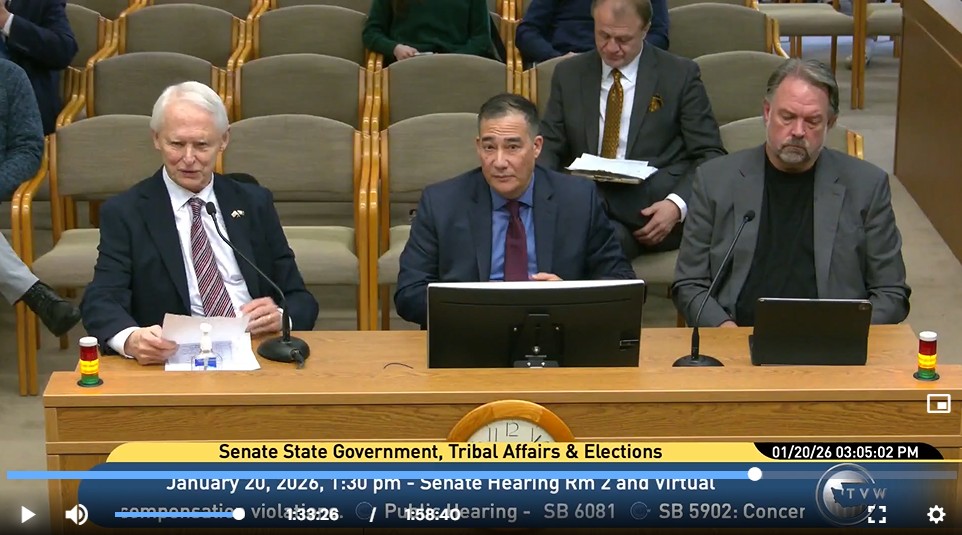
At Tuesday’s hearing, current and former state elections officials testified in opposition to this year’s proposal to restrict initiative campaigns. From left, former Secretary of State Sam Reed, current Secretary of State Steve Hobbs and initiative backer Brian Heywood. To see video, click here.
OLYMPIA – Sen. Jeff Wilson, lead Republican on a Senate committee overseeing elections, says a new proposal to restrict paid signature drives would make it so difficult to run initiative campaigns that it would nearly obliterate a cherished constitutional right and squelch the voice of the people.
More than 10,000 people signed in to express their opposition to Senate Bill 5973 prior to a Tuesday hearing in the Senate State Government, Tribal Affairs and Elections Committee. The measure, sponsored by majority Democrats, has been fast-tracked for a committee vote on Friday. A companion measure in the House, House Bill 2259, is scheduled for a hearing Wednesday.
The measure would ban initiative campaigns from paying canvassers by the signature, a practice that became commonplace in the 1990s. Sponsors say the bill is a response to a “recurring pattern of fraud” by paid signature gatherers. But Wilson, R-Longview, noted that there have been only a handful of cases of signature fraud over the last three decades, all were detected by state elections officials or by the campaigns themselves, and none have been reported in the last 13 years.
The measure would make it so difficult to qualify an initiative for the ballot that it would put the option out of reach in most cases and deny the people their right to override the Legislature, Wilson said.
“If anyone thinks this is about fraud, they should tell it to Santa Claus and the Easter Bunny,” Wilson said. “This bill would allow Olympia politicians to push their agendas without interference from the people.”
Pay-per-signature became the norm in the 1990s when the number of signatures required to place a measure on the ballot or before the Legislature climbed into the hundreds of thousands. Campaigns currently must present 308,911 valid signatures from registered voters to state election authorities, and they are given only a limited time to collect them between issuance of a state-approved ballot title and deadlines for petitions to be turned in.
The measure also would impose a new requirement on initiative campaigns that they submit 1,000 signatures when they file a measure, a process that could cut into the time available to collect signatures to qualify for the ballot. And it would give third parties the ability to sue to disqualify initiatives, potentially tying up campaigns in court while the clock is ticking.
Top state elections officials testified against the measure at Tuesday’s hearing. Secretary of State Steve Hobbs said fraud does not appear to be a problem in Washington state and that his office already has a robust mechanism to detect fraudulent signatures. Former Secretary of State Sam Reed called SB 5973 a “voter suppression bill” that would make it “even more difficult for the people to participate in the political process.”
Prior to Tuesday’s hearing, 10,520 people signed on to the Legislature’s website to express opposition to the bill. Some 1,173 registered their support.
Wilson said afterward that the bill would all but eliminate an important safety valve written into the state constitution in 1911 by the Legislature and the voters of Washington state.
“The initiative process allows the people of this state to pass the laws the Legislature won’t and prevent Olympia from going too far. Over the years we’ve used it for everything from permitting colored oleomargarine to banning state-sanctioned racial discrimination. But if Senate Bill 5973 passes, Washington voters will largely be prevented from exercising what our state constitution calls ‘the first power reserved by the people.’
“I am encouraged to see so many concerned citizens weigh in on this legislation. These numbers are too big to ignore. The people are sending a clear message to the Legislature that they don’t want it monkeying around with their constitutional rights. They’re saying, this is our government, and we would like to maintain control of it. They are reminding us, government is here to serve us and not the other way around.
“I think all of us who care about the survival of our system should be disturbed by this effort by the majority party, year after year, to impose new restrictions on the initiative process. I hope my colleagues recognize the importance of maintaining public confidence in our government, and we don’t do that by putting the people on mute.”
The measure is far from the first time the Legislature has considered measures to restrict the people’s right of initiative. Numerous mechanisms have been proposed since the 1990s, and with increasing frequency since the Legislature fell under one-party control in 2018. In 1993 the Washington Legislature, then under Democratic control, passed a similar bill banning pay-by signature. The law was overturned in federal district court in 1994 as an unconstitutional restriction on political speech.
The court ruled that if the Washington State Legislature wishes to restrict political speech, it must provide actual evidence of fraud, rather than speculating that fraud might be possible. It suggested the state may need to demonstrate that fraud is more prevalent in paid signature drives than in volunteer campaigns. At Tuesday’s hearing, Sen. Wilson cited the court ruling and asked whether any such evidence is available, but he drew blanks from committee staff.